Sign up for our newsletters
The best of Business news, in your inbox.

Recently, the time required for work permit approval has been shortened. This article will once again explain the relationship between visas and work permits, the types of visas, and the methods and time required for acquisition.
The first point to understand is that visas and work permits are entirely separate systems. Confusing these two poses a significant risk for Japanese expatriates planning to stay and work in Vietnam.
Visa: Grants entry and residency status. Various types exist depending on the purpose, from short-term stays to long-term residence.
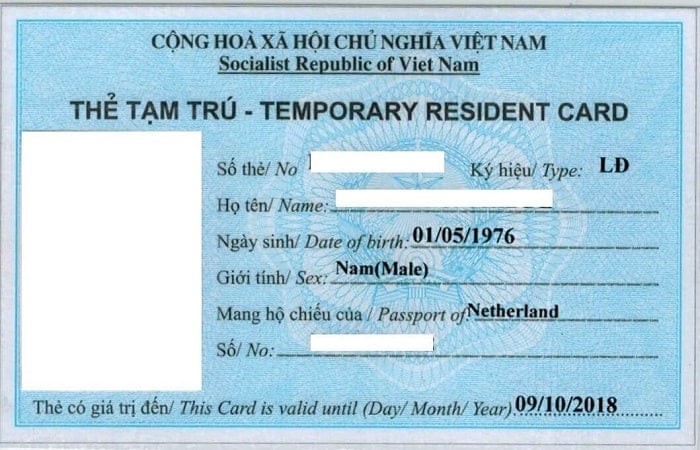
The image below shows a TRC (Temporary Residence Card), which is a type of visa. After obtaining a work permit, one can generally acquire a TRC for the same duration.
Work Permit (WP): This is the authorization required to work legally in Vietnam and demands a completely separate procedure from the visa.
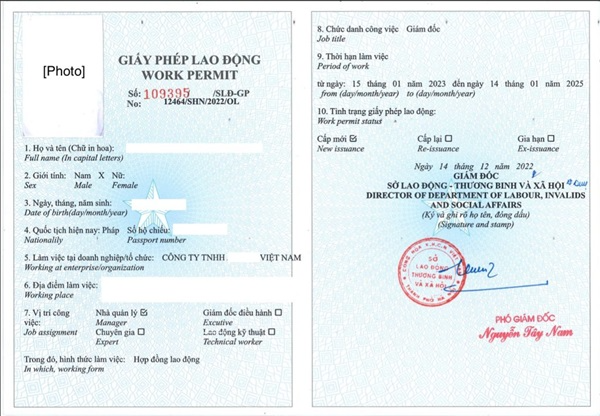
A common misconception is thinking, “My visa will be extended because my work permit is in progress.” This is incorrect. Even if a work permit application is pending, if the visa expires, it is considered an overstay, leading to risks of fines or deportation.
The work permit is also crucial for opening bank accounts and receiving salary. If a company transfers salary to an individual’s account without a work permit, banks may temporarily freeze the deposit and demand submission of the labor contract and work permit.
Therefore, for expatriates, both visas and work permits are essential; lacking either makes smooth living and work impossible.
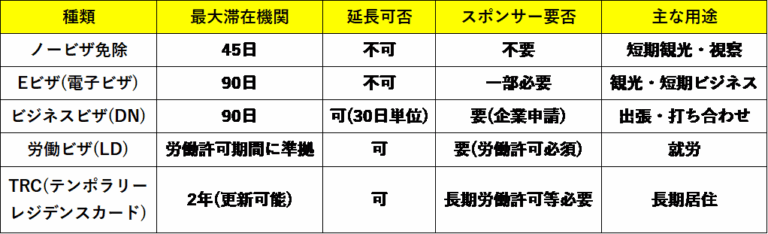
Visa Exemption:
Japanese passport holders can stay for up to 45 days without a visa. However, extensions are not permitted, limiting its use to short-term tourism or site visits.
E-visa (Electronic Visa):
Allows a stay of up to 90 days. It is highly convenient as it can be obtained online, but it cannot be extended. Used for tourism or short-term business trips.
Business Visa (DN Visa):
Allows a stay of up to 90 days. Extensions are possible, but an application from a sponsoring Vietnamese company is mandatory. Used for visiting clients or local meetings.
Labor Visa (LD Visa):
Issued corresponding to the duration of the work permit. This is a visa for employment and must be obtained as a set with the work permit.
Temporary Residence Card (TRC):
A long-term visa allowing a stay of up to 2 years, issued based on a work permit or other long-term residence qualifications. In practice, this is the most common residency status used by expatriates.
As seen, “stay duration,” “extendibility,” and “sponsor requirement” differ for each visa. For those planning long-term assignments, obtaining a TRC is the most stable option.
In practice, the residency status of the expatriate’s family is also extremely important. Vietnam’s system has the following rules:
Spouse: If the expatriate holds a work permit, the spouse can obtain a TRC.
Children under 18: Can apply for and obtain a TRC. This is essential for schooling and ensuring a stable living environment.
Children 18 and over: They are considered adults and cannot obtain a TRC. In this case, it is common to use the VR visa, which requires renewal every 6 months.
The new decrees have simplified the visa and work permit acquisition process.
Here are two typical acquisition patterns.
①: Case for Arranging Permits Before Travel and Then Entering
1. Recruitment Advertisement (5 working days)
2.Employment Approval & Work Permit Application (Within 10 days of application acceptance)
3.Obtain 90-day E-visa (5 working days)
4.After entering Vietnam, switch to TRC (5-7 working days)
This method is highly reliable and reduces the risk of being in an unstable position after entry.
②: Case for Applying for a Work Permit After Arriving
1.Use a visa letter to obtain a 90-day business visa and enter the country
2.Recruitment Advertisement (5 working days)
3.Work Permit Application (Within 10 days of application acceptance)
4.Switch to TRC (approx. 2 years) (5-7 working days)
In this case, documents that can only be obtained in Japan (like degree certificates, criminal record certificates) must be prepared before traveling. This requires coordinating between documents prepared in Japan and those prepared locally in Vietnam (like health checks).
To live and work smoothly in Vietnam, it is essential to always consider visas and work permits as an inseparable set.

Business Advisor
G.A. Consultants Vietnam Co., Ltd
After graduating from university, he joined a PHP research institute and served as the head of the New York office. He then worked on the “Nagoya Port Redevelopment Project” at a subsidiary of the Chubu Nippon Broadcasting (CBC) company. He later shifted his base to Asia, where he was involved in the launch of “FM96.3” in Singapore, and the creation of “Hello Vietnam” and “Invest Asia” magazines in Vietnam. He then joined BW Industrial Development JSC, Vietnam’s largest rental factory development company, where he was responsible for attracting Japanese manufacturing companies. Currently, he is active as a consultant for the entry of Japanese companies at “G.A. Consultants”, one of the longest-standing Japanese HR consulting firms in Vietnam.
The best of Business news, in your inbox.


