Sign up for our newsletters
The best of Business news, in your inbox.

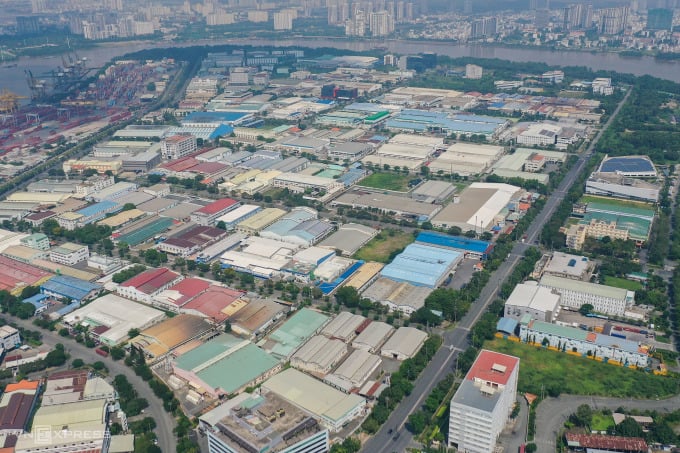
When manufacturing companies enter Vietnam, they typically face a choice between purchasing land in industrial parks to build their own factories or renting existing factory space. However, as Vietnam is a socialist country like China, foreigners cannot permanently purchase land; instead, they acquire land use rights for a maximum of 50 years. This period is calculated from the date the land receives its industrial land license. Therefore, in older industrial parks, such as the Tan Thuan Industrial Park in southern Ho Chi Minh City, there may only be 16 years left on the lease. This is something to keep in mind.
Usually, when the 50-year land use right expires, a new 50-year industrial land lease is often granted. However, in cases like the Tan Thuan Industrial Park, which is adjacent to urban areas, there is a possibility that the land could be converted from industrial to commercial use (e.g., for shopping centers or apartments). Thus, it’s crucial to verify the remaining lease period.
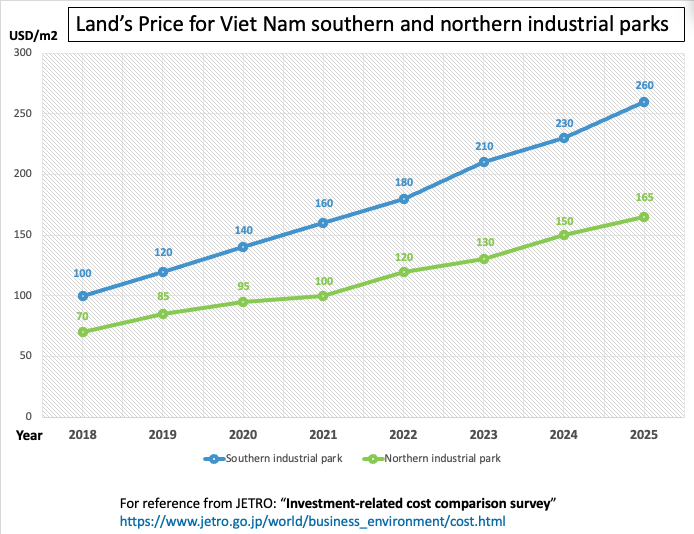
As shown in the list below, there is a price disparity for industrial park land between the northern and southern regions. In the south, particularly around Ho Chi Minh City, the limited availability of industrial land has led to a sharp increase in prices, now exceeding prices in the north by over 50%. In particular, industrial land prices in Dong Nai, Binh Duong, and Long An provinces near Ho Chi Minh City range from USD 200 to 300 per square meter. In contrast, in the north, even the recently developed Ecoland industrial park in Hung Yen province is priced at USD 140 per square meter, with no industrial parks currently exceeding USD 200 per square meter.
★ In Industrial Park A in Dong Nai, land prices have risen from USD 20 per square meter 20 years ago to USD 200 per square meter today, a tenfold increase.
★ In Industrial Park L in Long An, land prices rose from USD 40 per square meter 16 years ago to USD 280 per square meter, a sevenfold increase.
⇒ While residential and commercial land prices fluctuate with economic conditions, industrial land prices do not decrease even during economic downturns.
When entering the manufacturing sector in Vietnam, issues of infrastructure development and environmental protection must be considered. Currently, businesses can either purchase land within industrial parks to establish their factories or rent factory space within those parks; constructing factories on land outside industrial parks is not permitted. A recent trend involves companies first renting factory space for about 3 to 5 years. Once they establish a viable business, they often purchase land nearby to build their own factories. Buying land (land use rights) and constructing a factory outright can lead to substantial initial costs and present risks, as reselling can be challenging. If a company needs to exit, it could lead to significant debt burdens.

Business Advisor
G.A. Consultants Vietnam Co., Ltd
After graduating from university, he joined a PHP research institute and served as the head of the New York office. He then worked on the “Nagoya Port Redevelopment Project” at a subsidiary of the Chubu Nippon Broadcasting (CBC) company. He later shifted his base to Asia, where he was involved in the launch of “FM96.3” in Singapore, and the creation of “Hello Vietnam” and “Invest Asia” magazines in Vietnam. He then joined BW Industrial Development JSC, Vietnam’s largest rental factory development company, where he was responsible for attracting Japanese manufacturing companies. Currently, he is active as a consultant for the entry of Japanese companies at “G.A. Consultants”, one of the longest-standing Japanese HR consulting firms in Vietnam.
The best of Business news, in your inbox.


